
This entry was originally posted at Twice Bloomed Wisteria, my other site.
I've received my copy of Julie Zickefoose's book, Letters from Eden. It is part nature journal and part art book. I have been experiencing life through Julie's eyes since I found her blog through a National Public Radio podcast. She is a nature artist, writer, NPR commentator, mother, wife, bird watcher, and dog lover. Does everyone feel like they don't do enough, or am I the only one?
I was interested in Letters from Eden because I thought it would be a great Charlotte Mason inspired nature study book. The book is divided by seasons and is then further divided into stories about interacting with species and nature found during that season. Her writing is honest, many times humorous, and filled with great information. Even though Julie's seasons in Ohio don't exactly match my seasons in Mississippi, I am still enthralled with the book as a nature study resource and a beautiful coffee table book. The children and I will begin reading the book together in January so we can start at the beginning of the book move through the seasons. I have to confess that I have already started reading. I just couldn't help myself.
Friday, September 29, 2006


Tuesday, August 29, 2006
Having fun in history
This entry was originally posted at my other site, Twice Bloomed Wisteria.
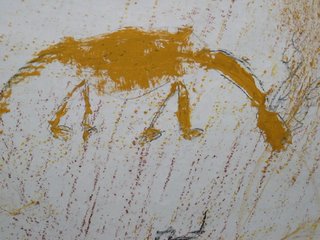 I think I have mentioned earlier that our home school is using The World in Ancient Times series published by Oxford for our history reading. We are loving the stories about archaeologists, anthropologists, and paleontologists in the first book, The Early Human World, who are making discoveries and attempting to place the pieces of our past. Yesterday, we read about Jean-Marie Chauvet, Christian Hillaire, and Eliette Deschamps finding cave art in December of 1994. The thrill of making a discovery and the significance of the art in the research of our past is documented in just enough detail for the children. Though the book has some great pictures, we took it a step further and looked at more pictures in Sister Wendy Beckett's The Story of Painting and the really cool website of the Cave of Chauvet-Pont-D'Arc.
 Take the tour!!
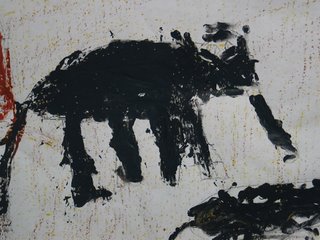
We, next, tried a cave art project from Art Smart by Susan Rodriguez. The children went outside and gathered sticks, dried grasses, bits of charcoal, and some roots to use as brushes. We then took butcher paper and placed it onto the concrete patio and texturized it with brown and tan crayons. After the paper was transformed into a cave wall, we hung it in the dog trot and Princess and Pink Panther started drawing animals and hands. They both commented that using the found tools was much more difficult and if they had it to do over again, they would know which things would make better tools and could do a better job.
I was excited because all the elements - books, art project, Internet site - came together to create something tangible, something fun, something they will remember. My husband came home and said that if it were darker he would have thought he was in a cave. That was just enough encouragement for the children to add more paper and art to the hallway. As long as I don't trip on the skull of a cave bear (or any other creature for that matter), let the transformations begin.
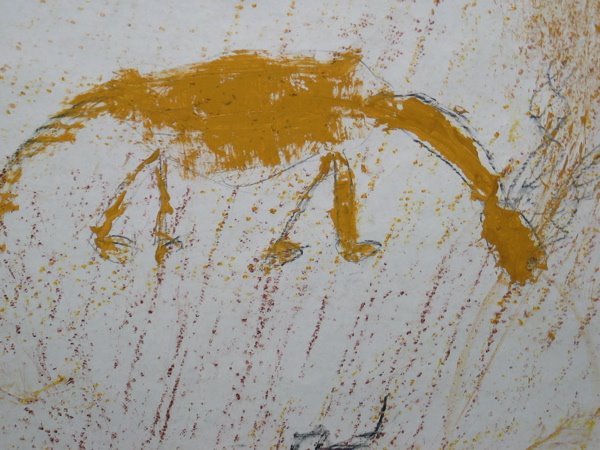 I think I have mentioned earlier that our home school is using The World in Ancient Times series published by Oxford for our history reading. We are loving the stories about archaeologists, anthropologists, and paleontologists in the first book, The Early Human World, who are making discoveries and attempting to place the pieces of our past. Yesterday, we read about Jean-Marie Chauvet, Christian Hillaire, and Eliette Deschamps finding cave art in December of 1994. The thrill of making a discovery and the significance of the art in the research of our past is documented in just enough detail for the children. Though the book has some great pictures, we took it a step further and looked at more pictures in Sister Wendy Beckett's The Story of Painting and the really cool website of the Cave of Chauvet-Pont-D'Arc.
 Take the tour!!
We, next, tried a cave art project from Art Smart by Susan Rodriguez. The children went outside and gathered sticks, dried grasses, bits of charcoal, and some roots to use as brushes. We then took butcher paper and placed it onto the concrete patio and texturized it with brown and tan crayons. After the paper was transformed into a cave wall, we hung it in the dog trot and Princess and Pink Panther started drawing animals and hands. They both commented that using the found tools was much more difficult and if they had it to do over again, they would know which things would make better tools and could do a better job.
I was excited because all the elements - books, art project, Internet site - came together to create something tangible, something fun, something they will remember. My husband came home and said that if it were darker he would have thought he was in a cave. That was just enough encouragement for the children to add more paper and art to the hallway. As long as I don't trip on the skull of a cave bear (or any other creature for that matter), let the transformations begin.
Tuesday, August 22, 2006
Extinguishing Fires
 My sister gave my children a bunch of puzzles. Among them was a 3-d house puzzle, a glow in the dark puzzle, a 3 little pigs puzzle, and various animal puzzles, especially horse puzzles. I love puzzles - jigsaw, pencil and paper, visual, logic - and I am fairly good at them. Herein lies a problem.
I realized the problem this weekend as the children and I were assembling. As I was plipping pieces in place as quickly as I could my son got up and left the table. He said, "I'm not good at puzzles." At that moment, I realized that I had allowed my personal space to swell so large that I pushed my children out - completely out of the room. I was able to get him to come back, but not with the same enthusiasm. Needless to say, I felt terrible. They were, after all, his and Princess's puzzles. I tried to explain that I had had much practice so it seemed easier when I was assembling. I knew that while I was practicing, I never had anyone reaching over my shoulder plipping pieces making me feel insecure about my lack of expertise. So, I stepped away from the table.
Saturday, July 29, 2006
Grammar
This was originally posted at my other site, Twice Bloomed Wisteria.
Our homeschool has been floundering with the study of grammar for a couple of years. Why, you ask, would a trained English teacher let her children flounder in the formal study of grammar? Well . . . I don't have an excuse except an inability to commit to a method and my false belief that I didn't know enough about teaching young children. When my son was 6 we started with First Language Lessons for the Well Trained Mind by Jesse Wise. I really liked the gentle method grammar was introduced while still imprinting the basic, yet important, lists and definitions. I enjoyed the program so well, that, my then, 3 year old daughter learned all the poetry, prepositions and helping verbs, among other things, along with her older brother because it looked so fun to march and dance around the house. Herein lies the problem. I found something I liked, that fit our family, and was successful using it. I have children who, at a young age, have retained much grammatical information. Now, I have high expectations without a next logical step. I looked at grammar program after grammar program. I never found a next level program that was just perfect. I tried to use many programs and investigated many others.
I tried G.U.M. by Zaner Bloser, the free online KISS grammar program, Shurley Grammar, and the free online Daily Grammar. I looked at several others, but didn't purchase or try to use them. Here is what I found:
In addition to reviewing and learning the grammar according to The Elements of Style, I will teach the children to deconstruct and analyze sentences through diagramming, edit writing, increase spelling efficiency, increase vocabulary, and write. Honestly, there is nothing new here. What is different, for us, is that with these flexible segments I can work with each child where he is, while letting them see the beauty and flexibility of our language, and giving them tools for effective communication. I am trusting myself, rather than a packaged plan. I will post more specifics when we begin using the plan.
Our homeschool has been floundering with the study of grammar for a couple of years. Why, you ask, would a trained English teacher let her children flounder in the formal study of grammar? Well . . . I don't have an excuse except an inability to commit to a method and my false belief that I didn't know enough about teaching young children. When my son was 6 we started with First Language Lessons for the Well Trained Mind by Jesse Wise. I really liked the gentle method grammar was introduced while still imprinting the basic, yet important, lists and definitions. I enjoyed the program so well, that, my then, 3 year old daughter learned all the poetry, prepositions and helping verbs, among other things, along with her older brother because it looked so fun to march and dance around the house. Herein lies the problem. I found something I liked, that fit our family, and was successful using it. I have children who, at a young age, have retained much grammatical information. Now, I have high expectations without a next logical step. I looked at grammar program after grammar program. I never found a next level program that was just perfect. I tried to use many programs and investigated many others.
I tried G.U.M. by Zaner Bloser, the free online KISS grammar program, Shurley Grammar, and the free online Daily Grammar. I looked at several others, but didn't purchase or try to use them. Here is what I found:
- G.U.M. - The grammar rules are presented in a straightforward manner. I liked that the child was not required to write out sentence after sentence to complete the exercises. The negative is that each sentence in the exercises is so similar to the others that once the first sentence is completed, the child isn't required to think. The patterns are fixed so that without even reading the sentence you could find subject and verb according to position in sentence. There is little to question or discuss. While saying this, I know that combined with other language activities this workbook could work. We completed most of these activities.
- Shurley Grammar - I know this is the favorite program of many people, but I found it unwieldy. There were just too many components to pull together for each lesson - jingle, study time, test time, scripted grammar time, reference grammar section, practice sentences, improved sentences, vocabulary. I would have liked the grammar songs and chants if we had not already mastered this information earlier. We liked the preposition and helping verb chants we created, not because they are better, but because we already knew them. Grammar concepts were not over practiced and the question and answer flows are helpful in analyzing sentences. Again, I found nothing wrong with the program, it was just not the right one for us. Shurley Grammar was just too comprehensive to work with the other things we were doing.
- KISS - I really like what is going on at this site. KISS is a work in progress, but could be unbelievable. Ed Vavra has taken excerpts from real books and has created grammar teaching tools. I chose not to use the program for a full year, not because it didn't match my grammar philosophy, but because I found that I spent too much time looking for the next section on the web site. Using excerpts challenges the student because the sentences do not follow an identifiable pattern. Ed has worked to get an organized printable workbook ready. I believe the 3rd grade level is ready now. This is a free resource so if it doesn't work no money is wasted.
- Daily Grammar - DG is a straightforward program of grammar teaching exercises. You, now, have several choices of how to receive your daily dose of grammar - email, archives, an ebook, or a workbook. The material is the same regardless of your choice. The email and archive versions are free. Daily Grammar gives you a rule and a couple of sentences for practice. We used most of the archive last year, yet I never felt like it was truly integrated into our other language arts activities. Overkill is not a problem, though.
- New concepts are added as the older ones are mastered.
- Students (older than 6 or 7) are able to take the memorized definitions and apply their knowledge to understand how sentences work.
- The ability to analyze sentences increases as reading proficiency increases.
- Sentence structure patterns become recognizable because more sentences have been viewed.
- Communicating in writing becomes more important and the ideas communicated become more complex, increasing the need for grammar and usage mechanisms.
In addition to reviewing and learning the grammar according to The Elements of Style, I will teach the children to deconstruct and analyze sentences through diagramming, edit writing, increase spelling efficiency, increase vocabulary, and write. Honestly, there is nothing new here. What is different, for us, is that with these flexible segments I can work with each child where he is, while letting them see the beauty and flexibility of our language, and giving them tools for effective communication. I am trusting myself, rather than a packaged plan. I will post more specifics when we begin using the plan.
Monday, June 26, 2006
Cool Free Resources for On the Go Homeschoolers
This entry was originally posted at my other site, Twice Bloomed Wisteria.
We spend a great deal of time in the car or waiting for a lesson to be finished. I always take books, books on tape, math fact practice, or Latin pronunciation practice. But, sometimes we want more - a little something different. I have found a solution or a few solutions - Podcasts!
Podcasts have become popular because so many people have high speed internet and mp3 players and because many people find it difficult to tune in to a particular series because of so many other time commitments. NPR, National Geographic, NASA and others have made it easy to find the stories in your interest area. Once you subscribe to the podcast or sometimes before, you can pick and choose the episodes you would like to hear or fit into your current study. You may then download and listen to the podcasts at your convenience, as many times as you like. I hate it when there is a great story on the radio and we get to ballet and I have to get out of the car and miss 10 minutes or the end. You don't have that problem with podcasts - just click pause.
Here is a sampler of some of the educational podcasts available:
What I do know is that our weekly travel time will be more interesting and more educational. Podcasts are not just for the car or iPod, I listen to the NPR Story of the Day and NPR Weekly Book Reviews while toiling away at my computer.
Are there fun, interesting, educational podcasts that I have missed?
We spend a great deal of time in the car or waiting for a lesson to be finished. I always take books, books on tape, math fact practice, or Latin pronunciation practice. But, sometimes we want more - a little something different. I have found a solution or a few solutions - Podcasts!
Podcasts have become popular because so many people have high speed internet and mp3 players and because many people find it difficult to tune in to a particular series because of so many other time commitments. NPR, National Geographic, NASA and others have made it easy to find the stories in your interest area. Once you subscribe to the podcast or sometimes before, you can pick and choose the episodes you would like to hear or fit into your current study. You may then download and listen to the podcasts at your convenience, as many times as you like. I hate it when there is a great story on the radio and we get to ballet and I have to get out of the car and miss 10 minutes or the end. You don't have that problem with podcasts - just click pause.
Here is a sampler of some of the educational podcasts available:
- American Experience: a PBS production -- American Experience is a History Podcast with topics such as Riding the Rails, Behind the Scenes: The Man Behind Hitler, Annie Oakley, Jessie James, and Victory in the Pacific. The time on these range from 5 minutes to 26 minutes.
- Nova --Short science stories from Nova are as diverse as can possibly be. There are stories about Mummies, Hurricanes, or Wetland Restoration.
- NPR Expeditions from National Geographic -- Typical stories include A Journey to the Edge of the Amazon, Societies of Sound in the Forest (insect sounds), and Sacred protection for Medicinal Plants.
- Science @ NASA -- Great stories from NASA like The Pull of Jupiter, Jupiter's New Red Spot, Planets around Dead Stars, and Suit Sat.
- NPR - Story of the Day --These stories are not all suitable for child listeners but stories like Chocolate's countless varieties, Dada on Display at the National Gallery, and In Praise of Don Knotts are interesting family choices.
- Nature Stories - Farming the Desert, Listening to the Private lives of Wolves, and Listening to the Northern Lights are a sampling of the stories in this environmental education podcast.
- Nature - Audio highlights from the international journal nature. Podcast segments are longer and the content is a bit more advanced, but no less interesting. Articles like Undersea volcanoes, genetic causes of deafness, the balmy arctic, and poisonous frogs.
What I do know is that our weekly travel time will be more interesting and more educational. Podcasts are not just for the car or iPod, I listen to the NPR Story of the Day and NPR Weekly Book Reviews while toiling away at my computer.
Are there fun, interesting, educational podcasts that I have missed?
Sunday, June 25, 2006
Typing 101
My son's handwriting is not great. We will keep pursuing legible writing, but I will begin to teach typing/keyboarding or whatever it is called now. I took typing in ninth grade when there was no question what to call it with an ancient rigidly coiffed teacher who gave "business" (secretarial) instructors the type in stereotype. We all rushed to that class, not because the class was so exciting, but to stake out the few electric typewriters. Even though class was typically amusing, it had nothing to do with the lessons and everything to do with the frazzled older teacher managing (or not) her class. I digress.
Anyway, I began researching typing/keyboarding programs a while back and I found out a couple of things. No matter what program you use, learning to type is not exciting. No matter how many cutesy characters they intersperse into the lessons - typing is typing. I don't ever remember anyone saying in my whole life, "Oh, I love typing. Please let me type that paper for you." I do remember people making a good living in college typing papers.
Anyway, here are the resources I found. Some are better than others:
Anyway, I began researching typing/keyboarding programs a while back and I found out a couple of things. No matter what program you use, learning to type is not exciting. No matter how many cutesy characters they intersperse into the lessons - typing is typing. I don't ever remember anyone saying in my whole life, "Oh, I love typing. Please let me type that paper for you." I do remember people making a good living in college typing papers.
Anyway, here are the resources I found. Some are better than others:
- Typing instruction in a book (much like I used when I was in 9th grade). I looked at a few of these, but decided that since the computer was already involved, why not use it as a resource for instruction as well.
- Typing for Kids! -- This is spiral bound, which is great for typing instruction since the pages lie flat, black and white line art book. The lessons take you slowly through the keyboard learning one or two keys per lesson. This is a basic approach and at $7.95 you can find much better in a computer oriented program.
- Keyboarding Skills -- Another spiral bound book for typing instruction. This one loses the cutesy drawings and adds speed. This book will take you further faster. If you really want a book, this one is for the older audience who really wants to type. I think this one was $19.95, but I wasn't that interested so I forgot to document.
- Typing computer programs -- I was stymied here for a while since most of the more documented programs have not kept up with technology or were not written for the Macintosh crowd. I eventually found several interesting typing tutors for modern machines (both Mac and PC) complete with bells and whistles.
- Mavis Beacon Teaches Typing 17 -- This is the newest of the Mavis Beacon typing empire (Make sure you get the version 17. The older programs are still floating around in the discount shops, but will not work with more modern machines). This program has oodles of bells and whistles, videos and arcade games, and lessons (231) and tests. This is a huge program. My question is this. Do you really need it all? The price is $40 or there about and you can download a free trial here.
- Learn2type.com -- Offers free typing instruction for both adults and children. The basics are covered in a basics section and then there are exercises in another section. There is nothing to stop the child from skipping the basics and moving into the exercises without instruction. Though the information in the basics section is sound, there is not as much practice of the basics to ensure that proper form or hand placement is achieved.
- Ten Thumbs Typing Tutor -- I like this Viking Typing Teacher. The on screen keyboard shows where the correct letter is so you don't have to look down. Lessons are short, can be repeated, and you get live stats. Some of this information is not important for the 10 year old boy, but for the parent who likes to play with the children's school resources, having all of the information is just grand. Another adult or child bonus is iTune connectivity. You can actually type the lyrics of the song you are hearing (if the lyrics are available). This is a shareware program for all operating systems so you can try it for a few days before deciding.
- Arcade Typing Tutor -- I am addicted to this program. The program is for practice only - no lessons here. You must shoot the meteors, spaceships, etc by typing the words associated object. Some of the spaceships shoot back, so be careful. Speed, only, is important. $11.99 and you are supporting a med school student - a feel good purchase for Mac only.
- Master Gecko's Home Row - I like this program for my 6 year old - though I hadn't thought much about teaching her typing, yet. I can read her writing. A gecko teaches the keyboard, then he introduces you to his friends in a maze game. Obviously, home row refers to the asdf - jkl; on the keyboard and you move forward from that point. You can choose levels - beginner, intermediate, or expert. This is a cheap any operating system program.
- There are hundreds of typing programs that I won't address here. This site gives you reviews and a screen shot of many of them. There should be something for everyone.
Friday, June 9, 2006
Summer Learning
Official school ended a few weeks ago. Yet, Summer is perfect for learning. The slower pace, fewer organized activities, and the longer days stimulate learning. Children are drawn outdoors and left to their own devices and amazing truths of nature are observed, the laws of physics are tested, muscles are developed, art is created, stories recounted, and mysteries solved. By letting children play and get bored you open the door to creative problem solving and learning.
I've heard, "Mama, I'm bored," at least a hundred times this summer, already. I respond in a similar way each time, "Go outside and play." I know that time spent wandering around on the farm is never wasted. Day-dreaming, scheming, exploring and testing are great activities that are best done when bored. While bored, my children dug a canal and built a dam. They made boats of paper and wood and floated them on the waterway. Experimenting with the water, dirt and miscellaneous pipe, wood, and other collected junk is certainly educational, but it is also fun. Yes, I could go stand out there with a book and direct the activities and bark out why those sticks won't work that way, but all that teaching would ruin it. Instead, my children have spent days experimenting and finally came up with a sturdy dam while I kept my mouth shut. I, as always, keep a watchful eye and ear pealed to the laboratory of the day, but try hard to stay out of it. I did overhear my son say, "How do the beavers do this so well with just dirt and sticks?" I think I overheard them discussing building a lock, next.
On another boring day, my children took a long walk to the spring. They found a fairy village in the moss and spent time "helping" the fairies by building some structure for their town. My sister and I used to pretend fairies in moss, with acorn cups, and rock tables. I told my children the story long ago. My children have now made their own stories and memories. I was told on my last walk to the spring, that I had stepped on a fairy garden. Oops! I have to be more careful.
Last week, my daughter folded a "nest" of paper, filled it with sunflower seeds, and climbed a tree. She placed the "nest" in an enticing place and waited. And waited. And waited.
Other days, I hear hammers banging. Construction has commenced. Or, they just ride their bikes, shoot targets with BB guns or bow, pick flowers, look for frogs or birds. I know that the unstructured learning is just as important as the more structured learning of the school year. I have to be patient with the messes created both inside and out. I have to remember that it is better for them to find out for themselves, rather than for me to tell them. I have to be available to help and rescue when needed but otherwise stay out of the way. I am rewarded with children who entertain themselves.
The children do go to the pool, participate in some organized activities, watch a few movies, and help build fences and other home and farm work, but Summer is all about roaming freely outside. I know roaming freely is not practical for city dweller children, but backyards, city and state parks, and inside the house can lead to similar exploration. Just remember to provide unscheduled time without an agenda. Let the child invent, while you watch.
I've heard, "Mama, I'm bored," at least a hundred times this summer, already. I respond in a similar way each time, "Go outside and play." I know that time spent wandering around on the farm is never wasted. Day-dreaming, scheming, exploring and testing are great activities that are best done when bored. While bored, my children dug a canal and built a dam. They made boats of paper and wood and floated them on the waterway. Experimenting with the water, dirt and miscellaneous pipe, wood, and other collected junk is certainly educational, but it is also fun. Yes, I could go stand out there with a book and direct the activities and bark out why those sticks won't work that way, but all that teaching would ruin it. Instead, my children have spent days experimenting and finally came up with a sturdy dam while I kept my mouth shut. I, as always, keep a watchful eye and ear pealed to the laboratory of the day, but try hard to stay out of it. I did overhear my son say, "How do the beavers do this so well with just dirt and sticks?" I think I overheard them discussing building a lock, next.
On another boring day, my children took a long walk to the spring. They found a fairy village in the moss and spent time "helping" the fairies by building some structure for their town. My sister and I used to pretend fairies in moss, with acorn cups, and rock tables. I told my children the story long ago. My children have now made their own stories and memories. I was told on my last walk to the spring, that I had stepped on a fairy garden. Oops! I have to be more careful.
Last week, my daughter folded a "nest" of paper, filled it with sunflower seeds, and climbed a tree. She placed the "nest" in an enticing place and waited. And waited. And waited.
Other days, I hear hammers banging. Construction has commenced. Or, they just ride their bikes, shoot targets with BB guns or bow, pick flowers, look for frogs or birds. I know that the unstructured learning is just as important as the more structured learning of the school year. I have to be patient with the messes created both inside and out. I have to remember that it is better for them to find out for themselves, rather than for me to tell them. I have to be available to help and rescue when needed but otherwise stay out of the way. I am rewarded with children who entertain themselves.
The children do go to the pool, participate in some organized activities, watch a few movies, and help build fences and other home and farm work, but Summer is all about roaming freely outside. I know roaming freely is not practical for city dweller children, but backyards, city and state parks, and inside the house can lead to similar exploration. Just remember to provide unscheduled time without an agenda. Let the child invent, while you watch.
Subscribe to:
Posts (Atom)